
A church website can feel familiar to everyone who already belongs and still leave a newcomer unsure where to begin. Ministry names, campus abbreviations, and announcements make sense inside the congregation, but someone considering a first visit needs a simpler introduction to the people, beliefs, and weekly life behind them.
That makes choosing a church web design agency a little different from hiring someone to refresh a homepage. You need a team that can give the church a recognizable identity while organizing service information, sermons, and events in a way your staff can keep current after launch.
The 13 agencies below approach that work from different directions, from parish websites to multi-campus churches and denominational organizations. Their projects give you something concrete to compare: how a church introduces itself, what visitors can find, and how the design supports the congregation’s everyday communication.
How we selected these church web design agencies
This shortlist brings together selected agency portfolios with identifiable church projects and published descriptions of the work involved. We looked for relevant design or development experience, useful content organization, and a public website you can explore alongside the agency’s account of its contribution.
BRIX Agency publishes this guide and appears first with work from our own portfolio. The specialties highlight different reasons to consider each team; they are a starting point for comparing relevant projects, your publishing needs, and the scope an agency would actually deliver.
The church web design agency shortlist
- BRIX Agency: A design and development agency creating church websites with distinctive identities, clear visitor information, and manageable content.
- Sunday Best: A church-focused studio combining website strategy, content planning, and Webflow development to make a congregation easier to explore.
- PlainJoe: A creative studio connecting church website design with content architecture and the systems that support a large congregation.
- Whiteboard: A design and technology agency translating an organization’s identity into a digital presence with a recognizable visual character.
- Landslide Creative: A website agency organizing church content and connected publishing tools so a small team can maintain a substantial site.
- TwoTone Creative: A creative agency connecting church website projects with video and recurring communications across the congregation’s other digital channels.
- VALKER: A digital studio rebuilding parish websites around practical information, manageable sections, and a clear introduction to church life.
- Long White Digital: A digital agency designing church websites with structured worship information and publishing features that staff can maintain in house.
- TwentyTwo Digital: A digital agency planning websites and information systems for organizations serving several audiences across a wider church network.
- Ten10 Creative: A creative studio developing church identities and websites with practical publishing features for the team responsible for ongoing updates.
- White Oak Media: A church design studio building websites that connect a congregation’s local character with visit information and community participation.
- Creative Church Marketing: A church marketing agency combining website work with ongoing creative and digital communications support for church teams.
- GUDBEE: A digital agency rebuilding church websites with mobile layouts and organized media content for congregations sharing sermons online.
1. BRIX Agency: Best Church Web Design Agency for Custom Design
 1
BRIX Agency
A design and development agency creating church websites with distinctive identities, clear visitor information, and manageable content.
At BRIX Agency, we design and develop websites that give an organization’s character room to come through. For a church, that means connecting its visual identity with practical information: what the congregation believes, how worship feels, and how someone can take a first step toward joining in.
Our work creating templates has given us experience arranging community-focused content in different ways, from lively, photography-led pages to quieter parish layouts. The projects below show how we adapted those foundations for church settings, keeping the congregation’s story connected to the information a visitor needs.
A closer look at our church web design portfolio
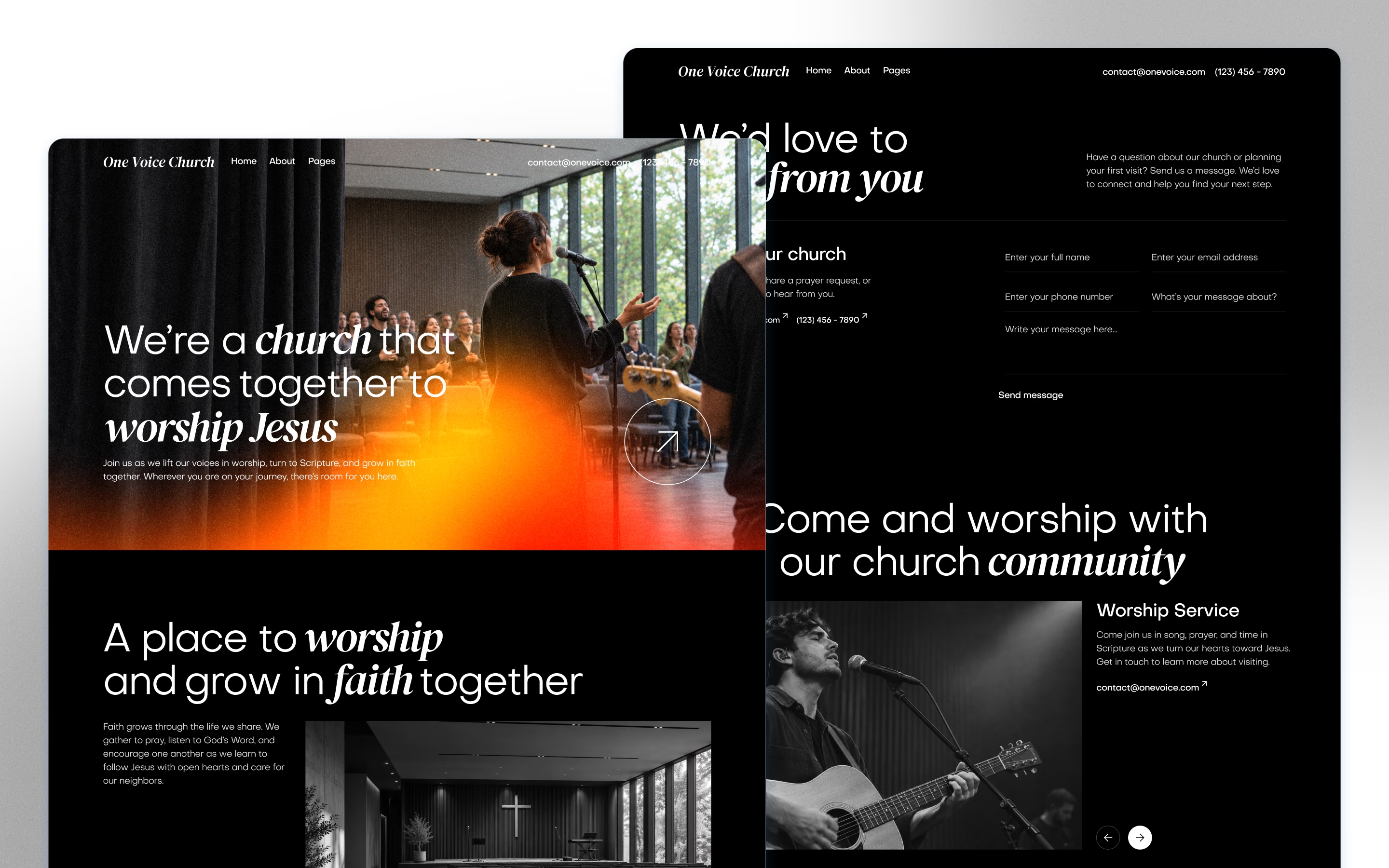
For One Voice Church, we adapted one of our templates around expressive worship photography and a dark, confident visual style. The large images establish a sense of shared participation, while the contact page carries that character into a straightforward way to reach the church. It connects the feeling of being there with a useful next step.
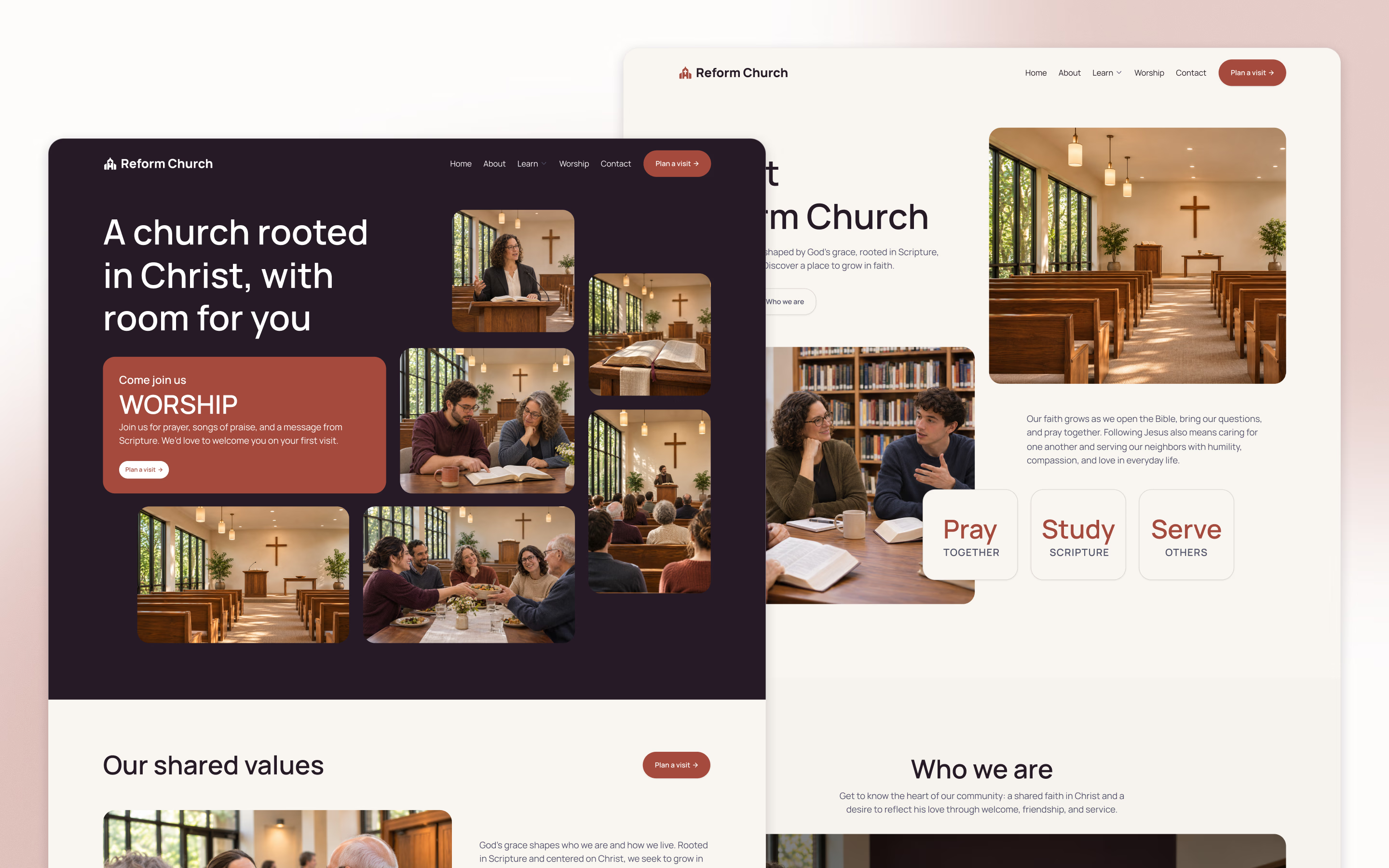
The Reform Church project takes a warmer approach. We adapted the layout with a collage of congregation photographs, deep plum sections, and contrasting calls to action, then gave the church’s story more space on a lighter about page. Those changes help the people and purpose remain visible as someone moves beyond the opening screen.
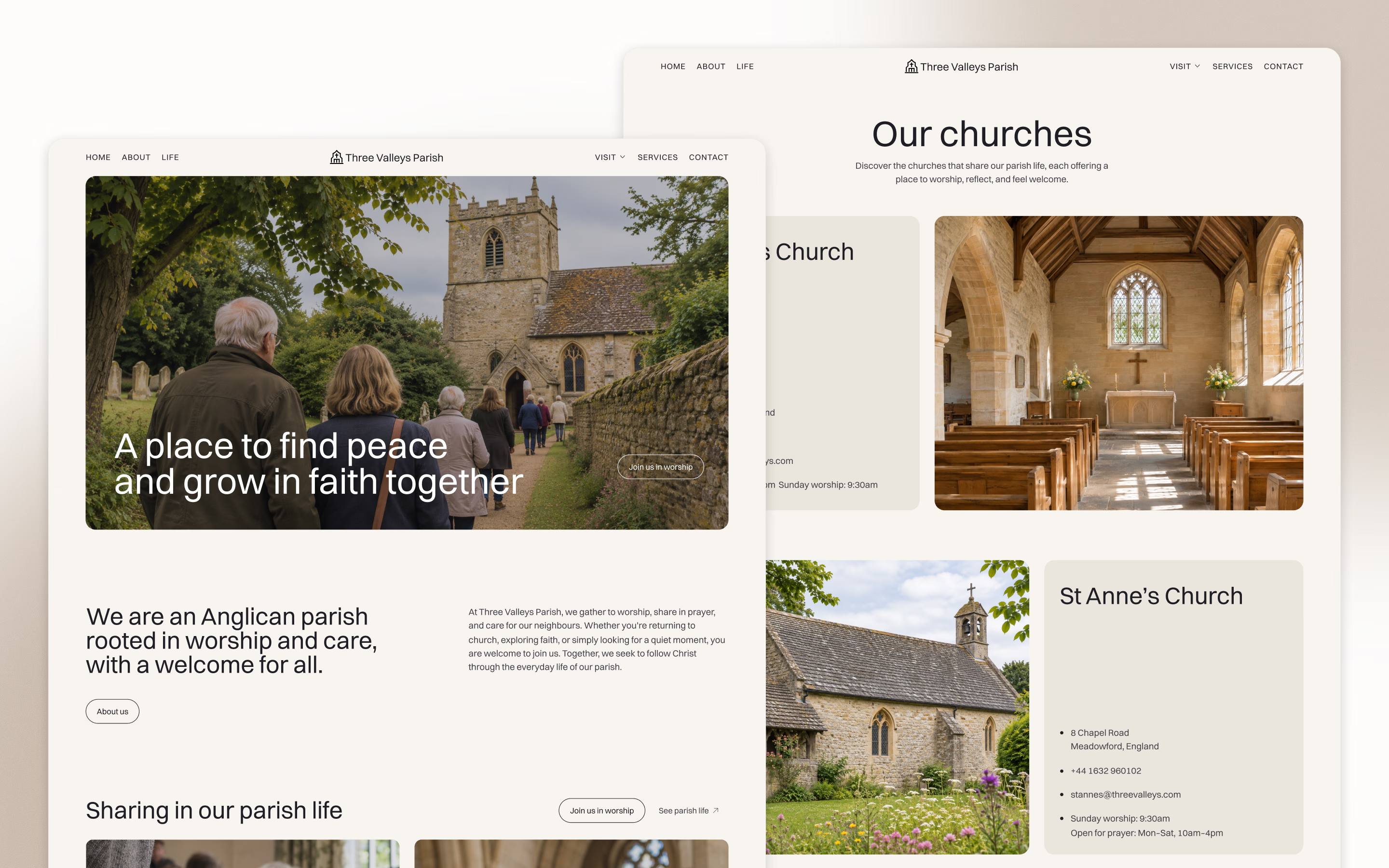
With Three Valleys Parish, we adapted the design to introduce several church communities through a calm, spacious layout. Building photography and individual church cards make the places recognizable, while parish information gives the wider group a shared identity. The result shows how a welcoming introduction can sit alongside the practical details of visiting a particular church.
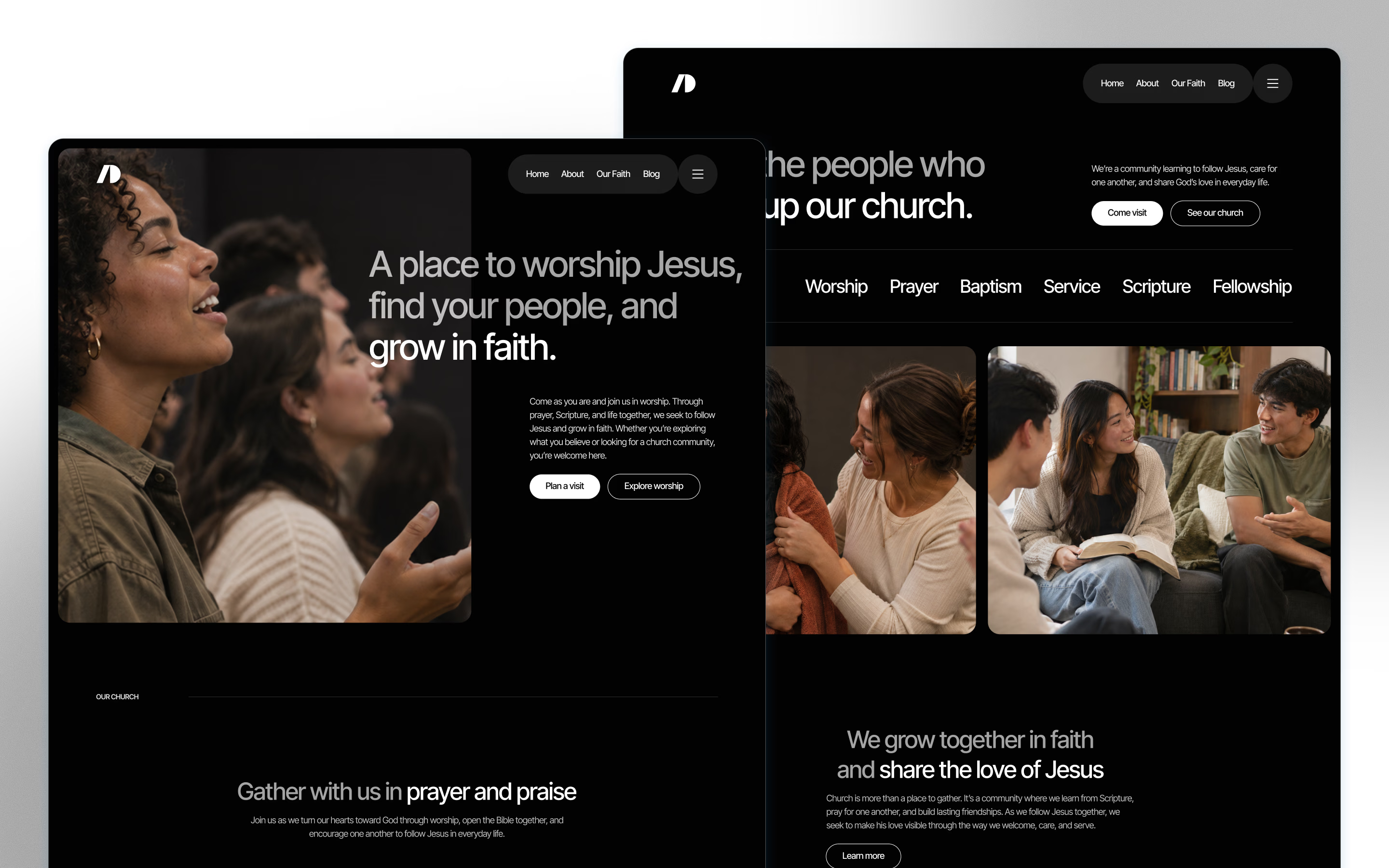
Our Worship and Fellowship project uses a darker palette with a different rhythm: large, restrained typography alongside photographs of church life. We adapted the template around worship, belonging, and faith, with the about page extending those themes through the congregation’s values. The design gives the message room to breathe without depending on a crowded opening screen.
Our templates are used by more than 60,000 websites across all categories. That experience informs the work shown here, and when you hire BRIX Agency, we create a fully custom website around your church’s identity, congregation, and goals.
2. Sunday Best: Best Church Web Design Agency for Visitor Journeys
 2
Sunday Best
A church-focused studio combining website strategy, content planning, and Webflow development to make a congregation easier to explore.
Sunday Best works on the choices that shape a church website before the polished screens arrive: what visitors should find, how pages connect, and what the staff will maintain. That makes its work relevant when a redesign needs to improve the underlying structure as well as the appearance.
Its Menlo Church engagement also shows the connection between creative work and handover. A site with multiple campus pages needs a consistent design, but it also needs an editing system that lets church staff keep those pages useful without rebuilding each one from scratch.
Featured project: Menlo Church
For Menlo Church, Sunday Best describes a project covering strategy, information architecture, wireframes, and custom Webflow design and development. The team moved the website from Squarespace, built its CMS and campus pages, and provided copy coaching and staff documentation. The visual implementation used supplied colors and typography within the new website.
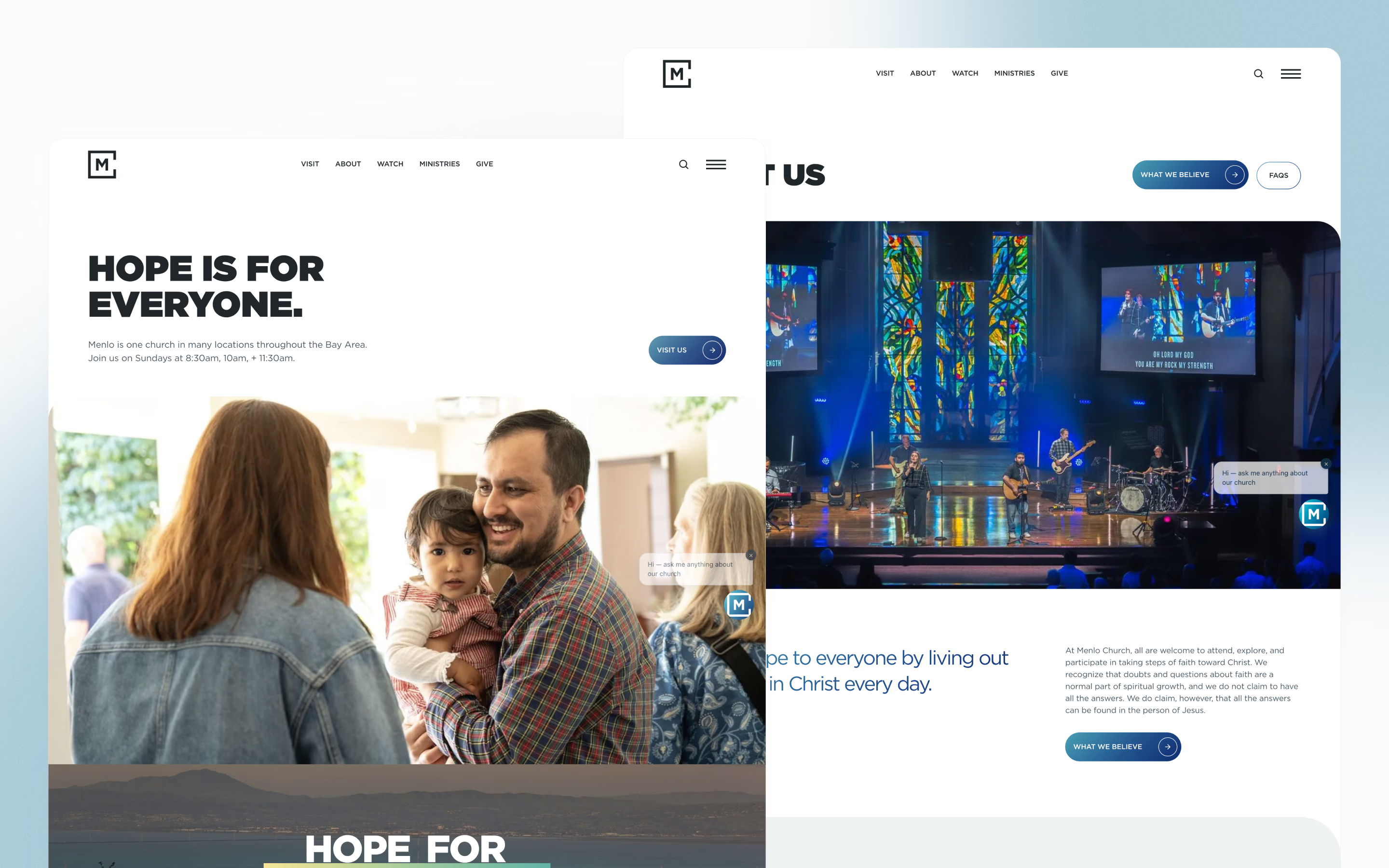
The selected pages pair a bold introduction with people-focused photography and clear paths into the church. For a congregation with several locations, the useful question is how the agency keeps that shared identity intact while giving each campus its own visit information. Menlo offers a concrete project to discuss when reviewing that balance.
3. PlainJoe: Best Church Web Design Agency for Church Integrations
 3
PlainJoe
A creative studio connecting church website design with content architecture and the systems that support a large congregation.
PlainJoe brings church storytelling into digital work, with The Church of Eleven22 showing a substantial website engagement. It is a useful team to consider when the website must connect a strong public identity with the information and software a church already depends on.
The distinction matters for larger congregations. A service page, a sermon archive, and a campus finder may look like separate design tasks, but visitors experience them as parts of the same church. The agency needs to make those transitions feel understandable rather than leaving each department with its own disconnected corner.
Featured project: The Church of Eleven22
PlainJoe’s documented work for The Church of Eleven22 included digital strategy, design, and a complete WordPress rebuild, with Rock RMS integration and sermon content architecture. Its role therefore extended beyond the homepage into the structure connecting church content and operational systems.
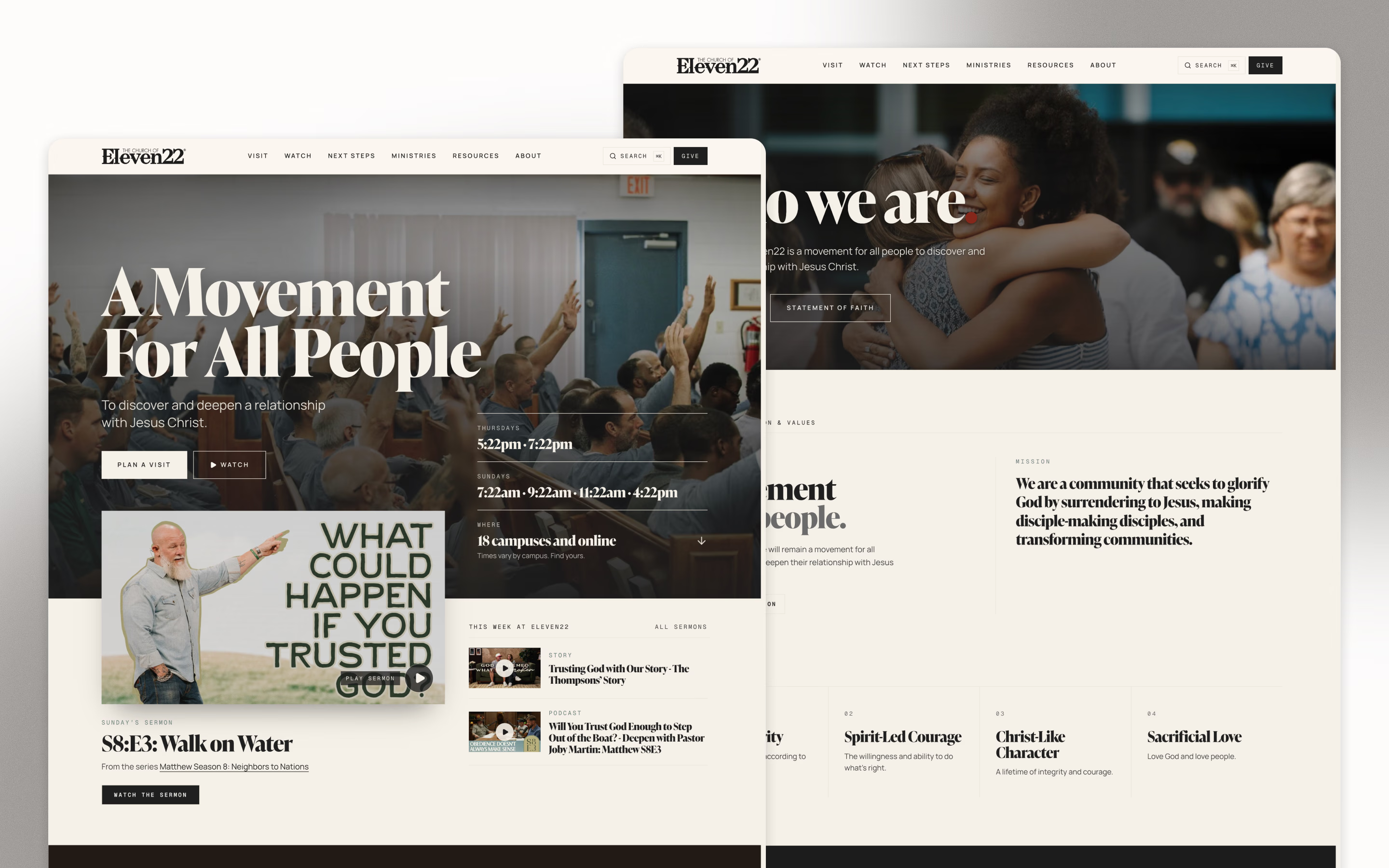
The church website places worship photography alongside prominent visit and sermon routes, with campus information available as part of that experience. Use the project to ask how an agency would organize your locations and connect your existing church management system. The proposal should identify the integration work as clearly as it describes the visual design.
4. Whiteboard: Best Church Web Design Agency for Brand Expression
 4
Whiteboard
A design and technology agency translating an organization’s identity into a digital presence with a recognizable visual character.
Whiteboard is worth exploring when the church’s identity needs attention alongside its website. Its work for Epic Church connects a reimagined brand with a digital home, giving you a project where the visual language and website presentation were considered together.
That approach can help a congregation whose existing materials no longer express who it is. The useful comparison is not whether you prefer a particular color or typeface, but whether the agency can carry a clear personality through the visit information, church story, and other pages people actually use.
Featured project: Epic Church
Whiteboard identifies Epic Church in its account of brand and no-code website work, describing a reimagined brand and digital home. The public Epic website also credits Whiteboard for design and build. The selected pages bring together warm backgrounds, generous typography, rounded photography, and an emphasis on community.
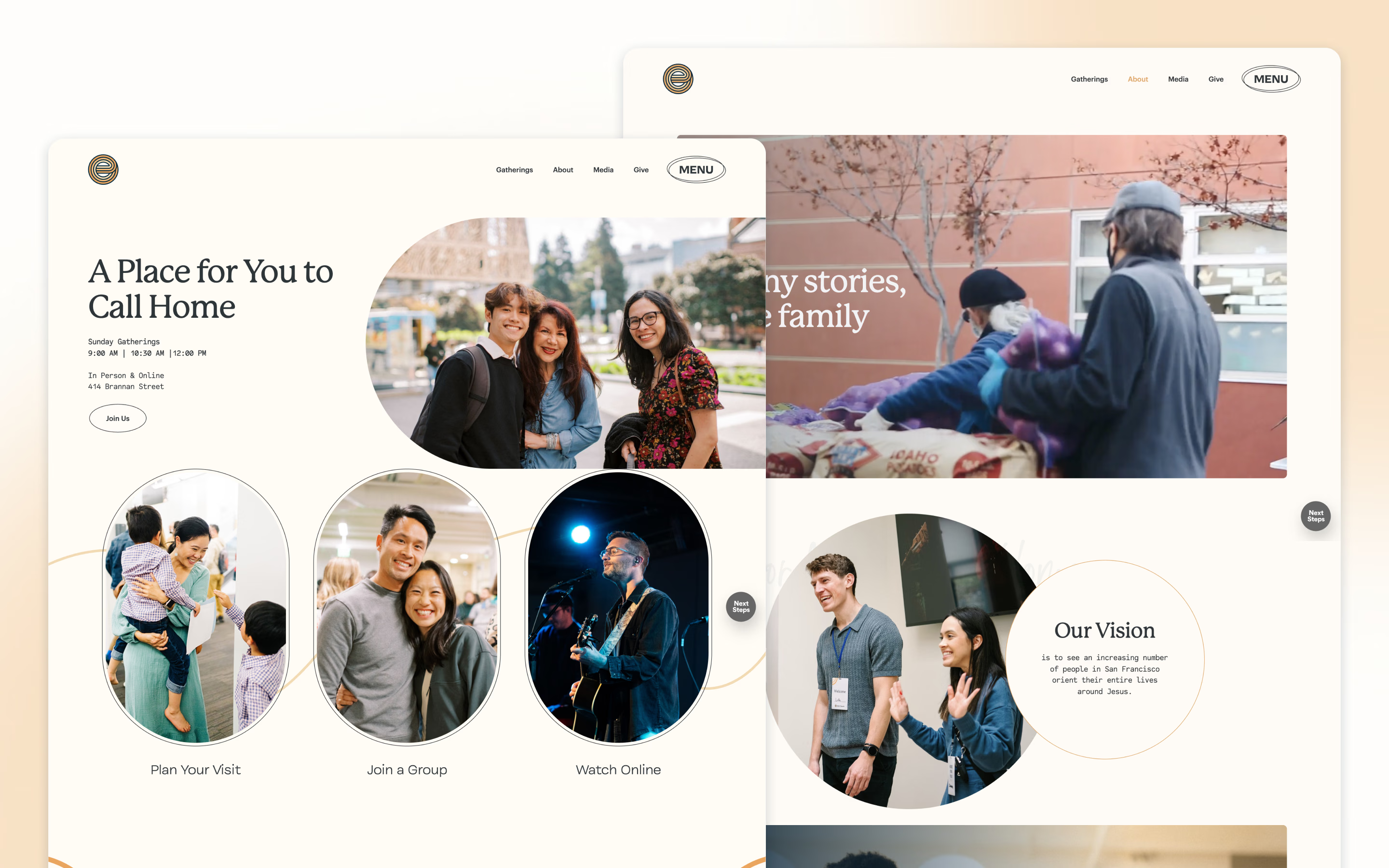
The design gives the church a friendly visual identity without relying on a dense opening screen. For your own brief, ask which brand elements would be developed, which would be retained, and how they would carry into interior pages. Those responsibilities should be explicit when branding and website work share a proposal.
5. Landslide Creative: Best Church Web Design Agency for Content Libraries
 5
Landslide Creative
A website agency organizing church content and connected publishing tools so a small team can maintain a substantial site.
Landslide Creative offers a relevant project for churches with more content than their current navigation can comfortably hold. Its Ingleside work brings together ministries, sermons, resources, and events, rather than treating the redesign as a collection of unrelated page refreshes.
The agency’s documented attention to a small content team is especially useful when staff capacity is part of the problem. A publishing structure should reduce repeated work, with clear places for recurring information and a sensible connection to the systems the church already updates.
Featured project: Ingleside Baptist Church
The Ingleside Baptist Church project involved a full website rebuild using the church’s existing brand guidance. Landslide reorganized its content, including sermons and resources, and connected the event calendar to its church management system so event listings could be published through that integration.
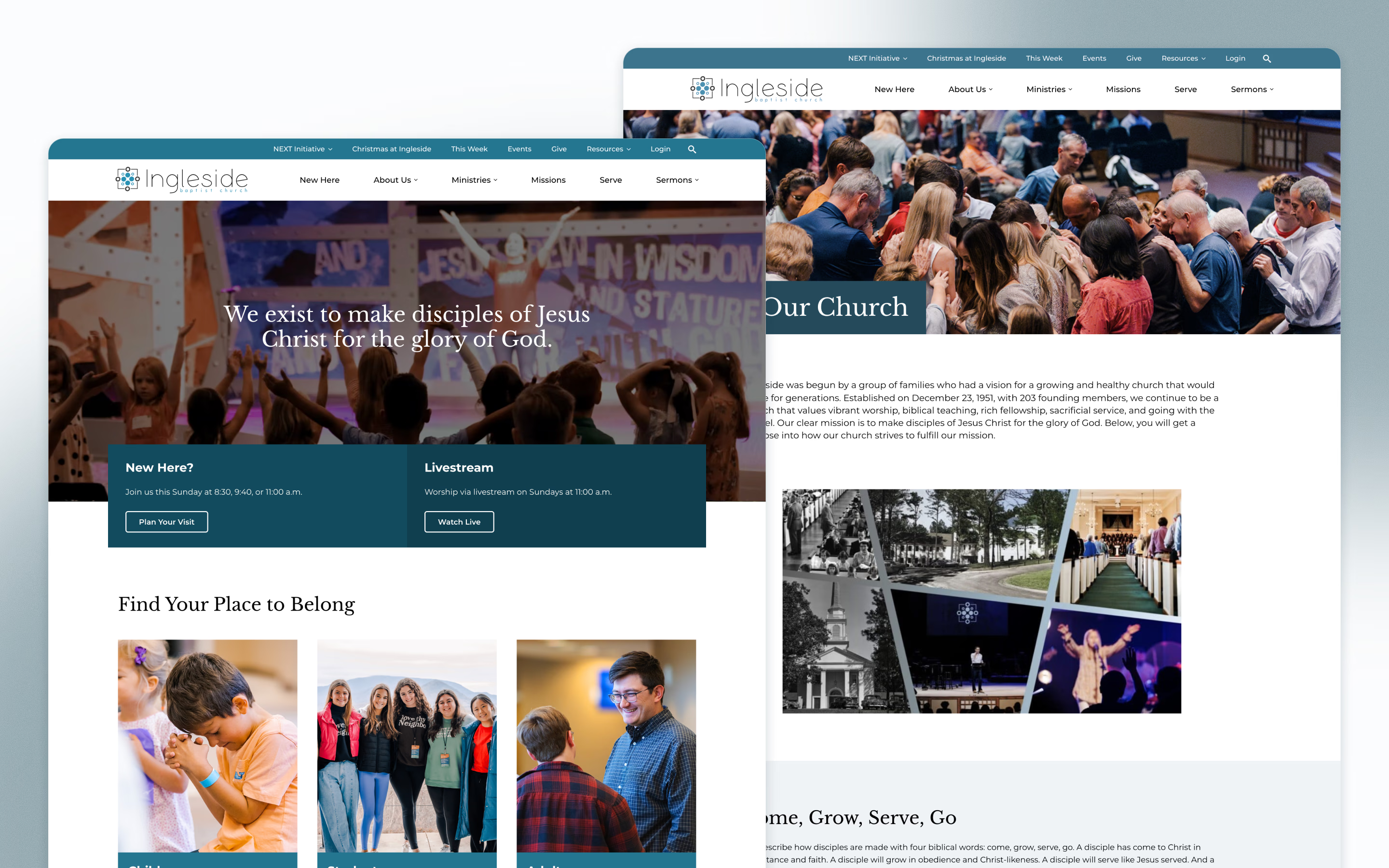
The selected design gives ministries and visit information distinct places within a consistent blue-and-green presentation. For a church with a large archive, ask the agency how it would classify existing content before migration and who would maintain each category afterward. Ingleside is a useful reference for discussing that work as part of the website scope.
6. TwoTone Creative: Best Church Web Design Agency for Church Communications
 6
TwoTone Creative
A creative agency connecting church website projects with video and recurring communications across the congregation’s other digital channels.
TwoTone Creative suits a shortlist where the website is one part of a broader church communications project. Its LifeSpring engagement included work across several channels, making it relevant when a church wants a consistent voice and visual direction beyond the website itself.
That wider scope can be useful, but it should remain easy to understand. A church comparing proposals needs to know what belongs to the website build, what is a separate creative deliverable, and which communications will continue to require staff time or an ongoing agency arrangement.
Featured project: LifeSpring Church
For LifeSpring Church in Bellevue, Nebraska, TwoTone documents website design, development, and launch alongside video, social advertising, sermon recaps, and email templates. The selected website uses congregation photography, strong blue and orange accents, and visible paths for attending in person or watching online.
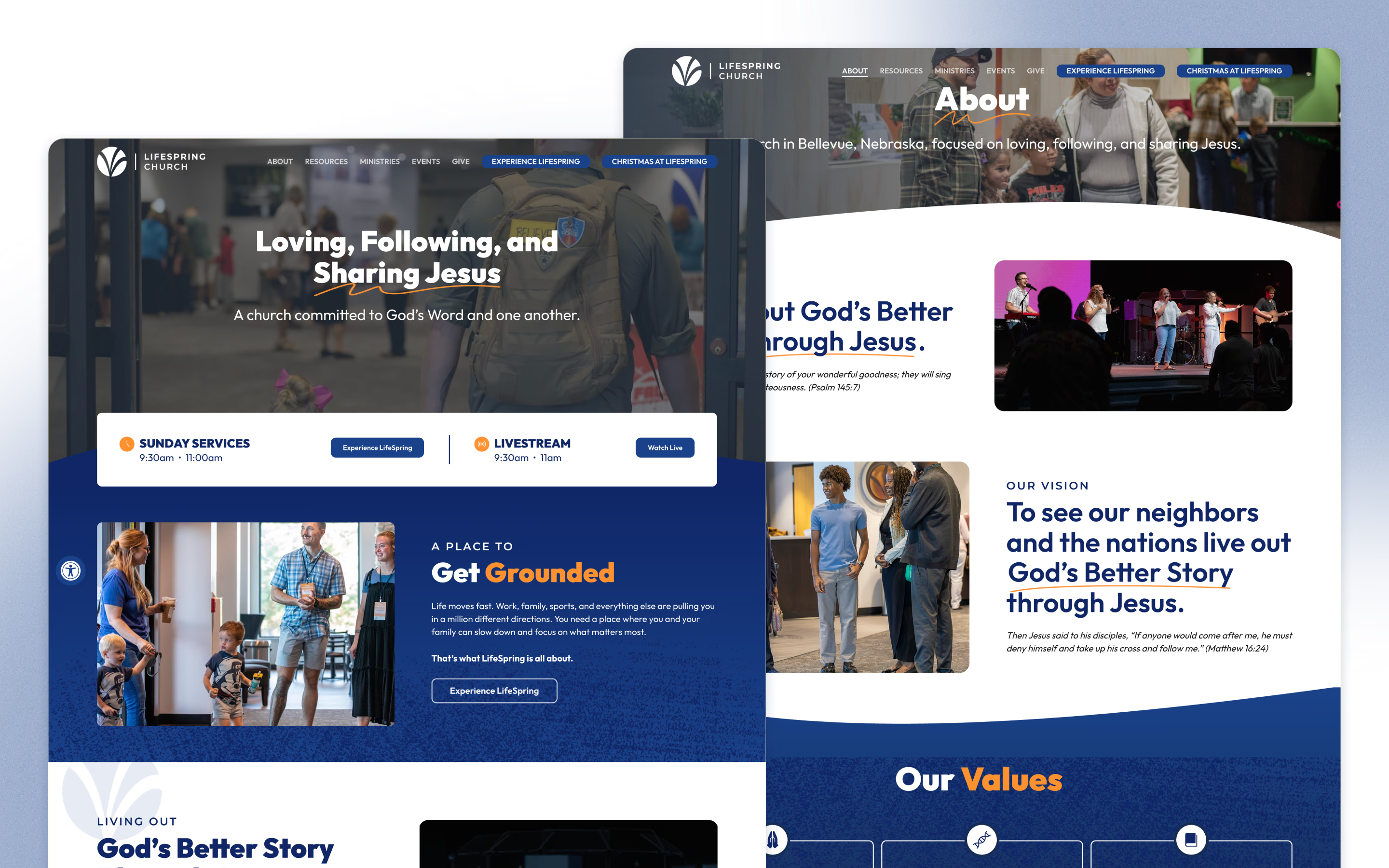
The project gives you a way to compare an integrated communications engagement with a website-only proposal. If your team also needs help preparing launch materials or recurring sermon content, ask for those responsibilities to be priced separately. That keeps the broader creative relationship useful without leaving the website deliverables vague.
7. VALKER: Best Church Web Design Agency for Content Simplification
 7
VALKER
A digital studio rebuilding parish websites around practical information, manageable sections, and a clear introduction to church life.
VALKER provides a smaller-scale parish project that deserves a place beside the larger church websites in this list. Its work for St James the Great focuses on making the church’s information understandable through a contained, practical website structure.
For a parish team, that can be more relevant than a large feature inventory. Services, life events, and notices need dependable homes, with enough flexibility to keep information current and enough restraint that occasional editors can find their way around the system.
Featured project: St James the Great, Old Milverton
VALKER rebuilt the St James the Great, Old Milverton website using Next.js and organized the parish content into seven practical sections. Its case describes information covering services, life events, and notices, with ongoing maintenance considered as part of the work. The church is an Anglican parish in England.
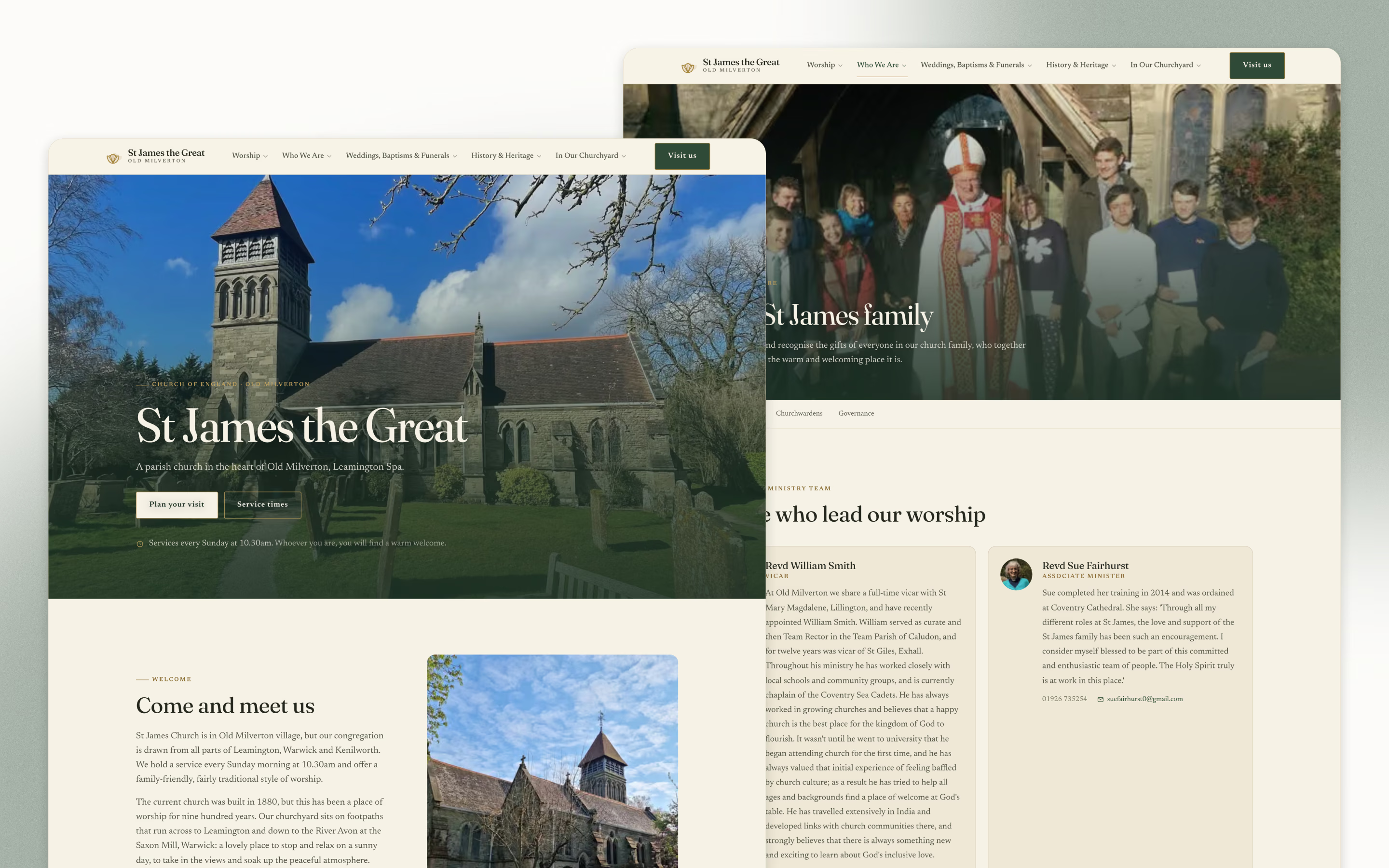
The selected design uses building photography, a restrained green palette, and readable introductory content to establish a sense of place. If you are considering a framework-based build, ask what publishing interface accompanies it and who maintains the software. The parish project is useful because the content task remains visible alongside the technology choice.
8. Long White Digital: Best Church Web Design Agency for Worship Content
 8
Long White Digital
A digital agency designing church websites with structured worship information and publishing features that staff can maintain in house.
Long White Digital is a relevant option when the website needs to reflect a church’s worship tradition in detail. Its St John’s Wood Church project includes content and publishing features that go beyond a general welcome page and a list of service times.
That matters for congregations where music, liturgy, and a changing worship calendar are central to the public experience. The website needs a clear visual identity, but the way it handles regular updates is just as important to the people responsible for keeping it accurate.
Featured project: St John’s Wood Church
The agency designed and built the St John’s Wood Church website with modular content, Google Calendar integration, music lists, and audio and video publishing. Its case describes a site intended for in-house maintenance, bringing several recurring church communications into a consistent structure.
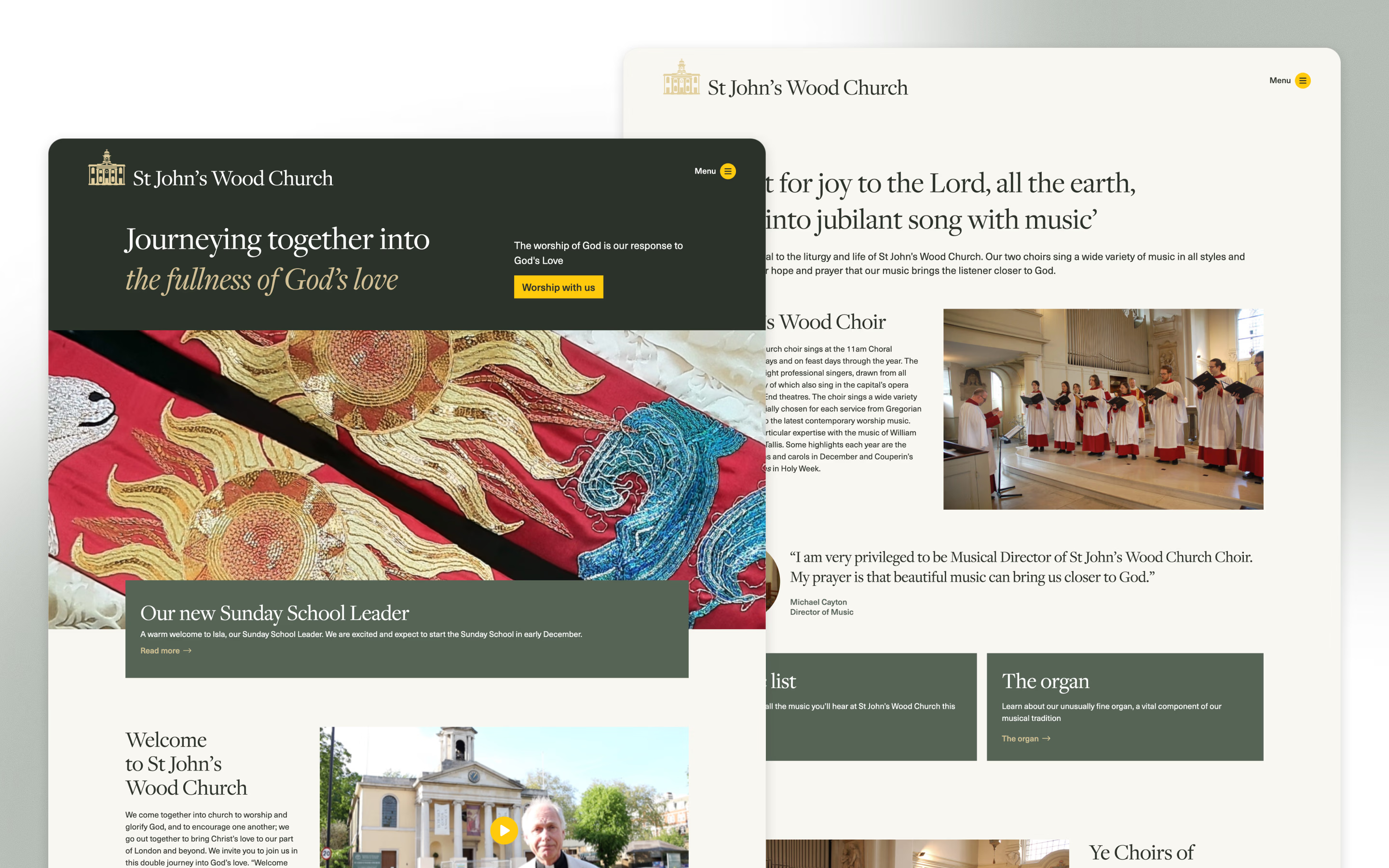
Deep green, light backgrounds, and church photography give the selected pages a distinctive parish character. When comparing an agency for similar work, discuss a normal week of updates, including who supplies music details and when the calendar changes. That conversation will reveal more about the fit than the homepage design alone.
9. TwentyTwo Digital: Best Church Web Design Agency for Denominational Websites
 9
TwentyTwo Digital
A digital agency planning websites and information systems for organizations serving several audiences across a wider church network.
TwentyTwo Digital brings a denominational project to the list, with an audience broader than the visitors to a single church. Its Queensland Synod engagement involved both a public website and a separate internal information environment.
That distinction is useful for church networks whose public pages have become crowded with staff resources and organizational material. An agency should be able to separate those needs thoughtfully, so visitors can understand the organization while internal users still have a dependable place to find their work.
Featured project: Uniting Church in Australia - Queensland Synod
For the Uniting Church in Australia’s Queensland Synod, TwentyTwo documents research, user-experience testing, a public website, and a separate internal hub with Microsoft-connected information flows. The selected image shows the public website, with its welcome, community content, and organizational information.
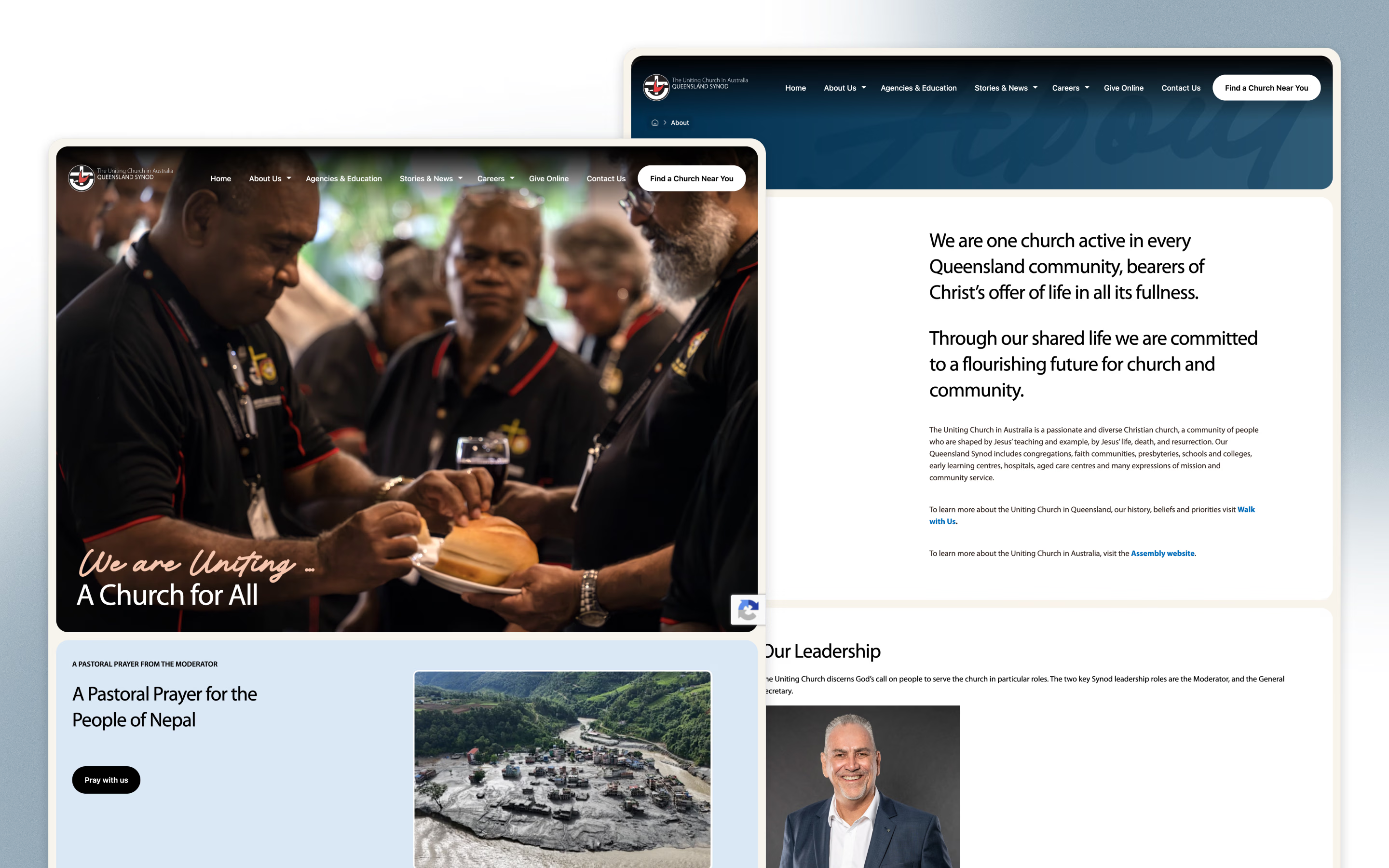
The project is relevant when your brief involves governance, multiple stakeholder groups, or resources distributed across a church network. Ask the agency to identify the audiences for each proposed site and where content will be maintained. Treat the internal hub as a separate scope item rather than assuming it comes with a public website redesign.
10. Ten10 Creative: Best Church Web Design Agency for Brand Systems
 10
Ten10 Creative
A creative studio developing church identities and websites with practical publishing features for the team responsible for ongoing updates.
Ten10 Creative offers a church project that joins identity work with website design and development. That makes it relevant when a congregation needs to bring its logo, visual materials, and website into a more consistent direction.
The website responsibilities still need their own definition within that larger creative task. A new visual identity does not decide how events get published or how staff update registrations, so a useful proposal should explain both the design system and the everyday content tools.
Featured project: First Baptist Church of Palm Coast
For First Baptist Church of Palm Coast, Ten10 describes a brand refresh, logo and visual identity work, and a custom website design and build. The website scope included an event calendar and registration features intended to be managed by church staff.
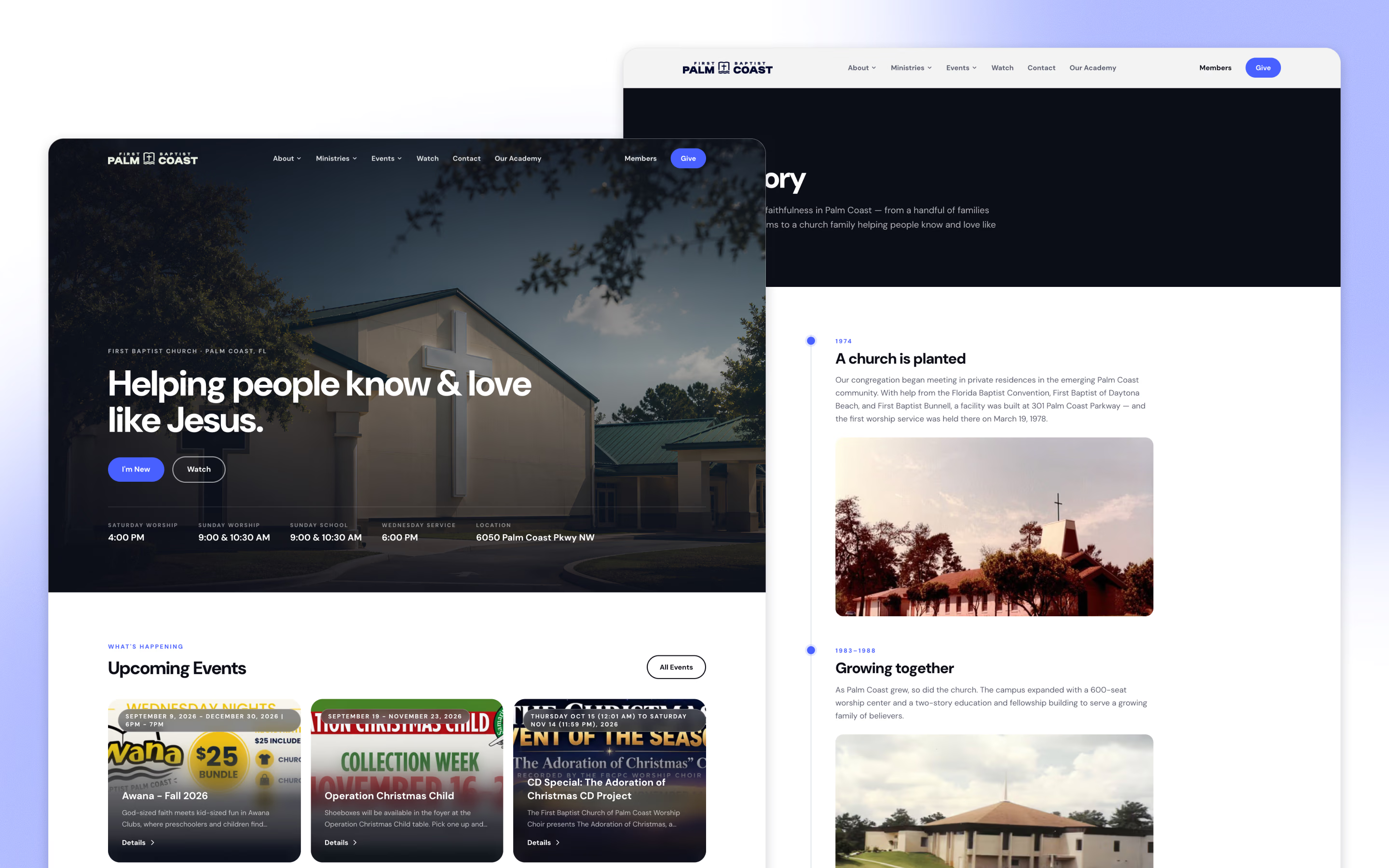
The selected pages use a dark blue foundation, large white headings, and contrasting calls to action, with event cards carrying that identity into practical content. It is a useful project to discuss when you want a recognizable church brand and a publishing setup that supports the people working with it each week.
11. White Oak Media: Best Church Web Design Agency for Local Identity
 11
White Oak Media
A church design studio building websites that connect a congregation’s local character with visit information and community participation.
White Oak Media shows how a church website can connect its visual identity to its location. The Fortress City project uses the church’s local setting as part of the introduction, while keeping the practical routes into church life close at hand.
It is a useful direction for congregations that want their website to feel rooted in the community they serve. In that kind of brief, the agency’s handling of photography, language, and visitor information matters more than choosing a visual style in isolation.
Featured project: Fortress City Church
White Oak Media documents a custom design and build for Fortress City Church in New Britain, Connecticut. The work covers newcomer and visit paths, groups and community content, event integration, and giving. This is a named custom engagement in the studio’s portfolio.
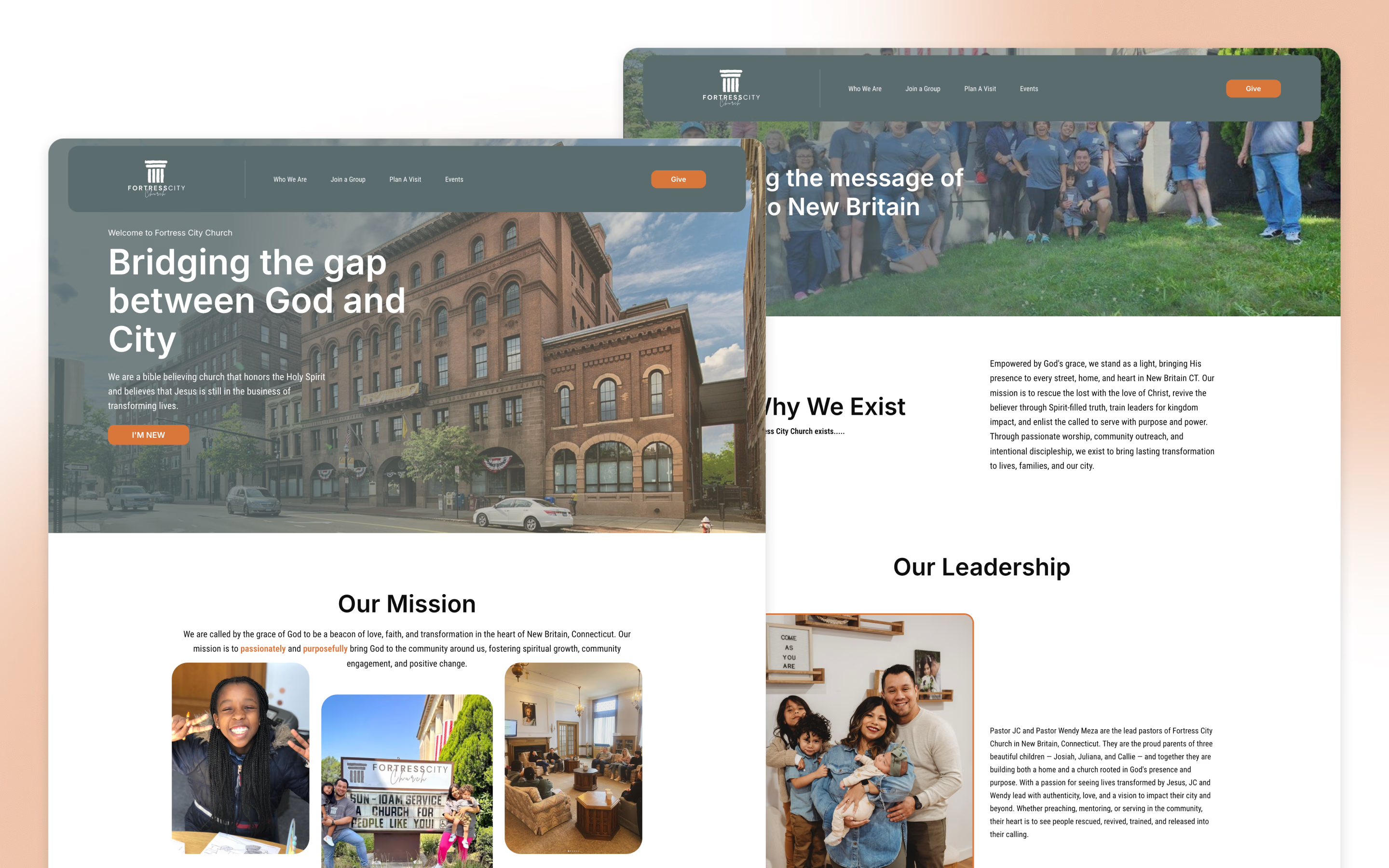
The selected website brings city photography together with teal and orange accents, giving the church an identifiable local presence. As you explore it, consider how your own location would appear across the site, including the address, arrival information, and community activities. Those details should feel connected to the design rather than added after it.
12. Creative Church Marketing: Best Church Web Design Agency for Managed Websites
 12
Creative Church Marketing
A church marketing agency combining website work with ongoing creative and digital communications support for church teams.
Creative Church Marketing is worth considering when your team is also comparing ongoing communications support. The agency offers website work alongside creative and marketing services, so the relationship can cover more than a single redesign.
For a church with limited staff time, the important question is how that ongoing arrangement works in practice. Ask which updates the church handles, what the agency maintains, and how requests are prioritized. Those responsibilities should be clear before you compare monthly costs.
Featured project: The Grove Church
The agency lists The Grove Church in its work, and the church’s public website carries its design credit. The selected pages introduce the Richmond, Texas congregation with a light palette, green accents, photography, and clear visit and sermon routes. The portfolio supports the website attribution without establishing additional custom integrations.
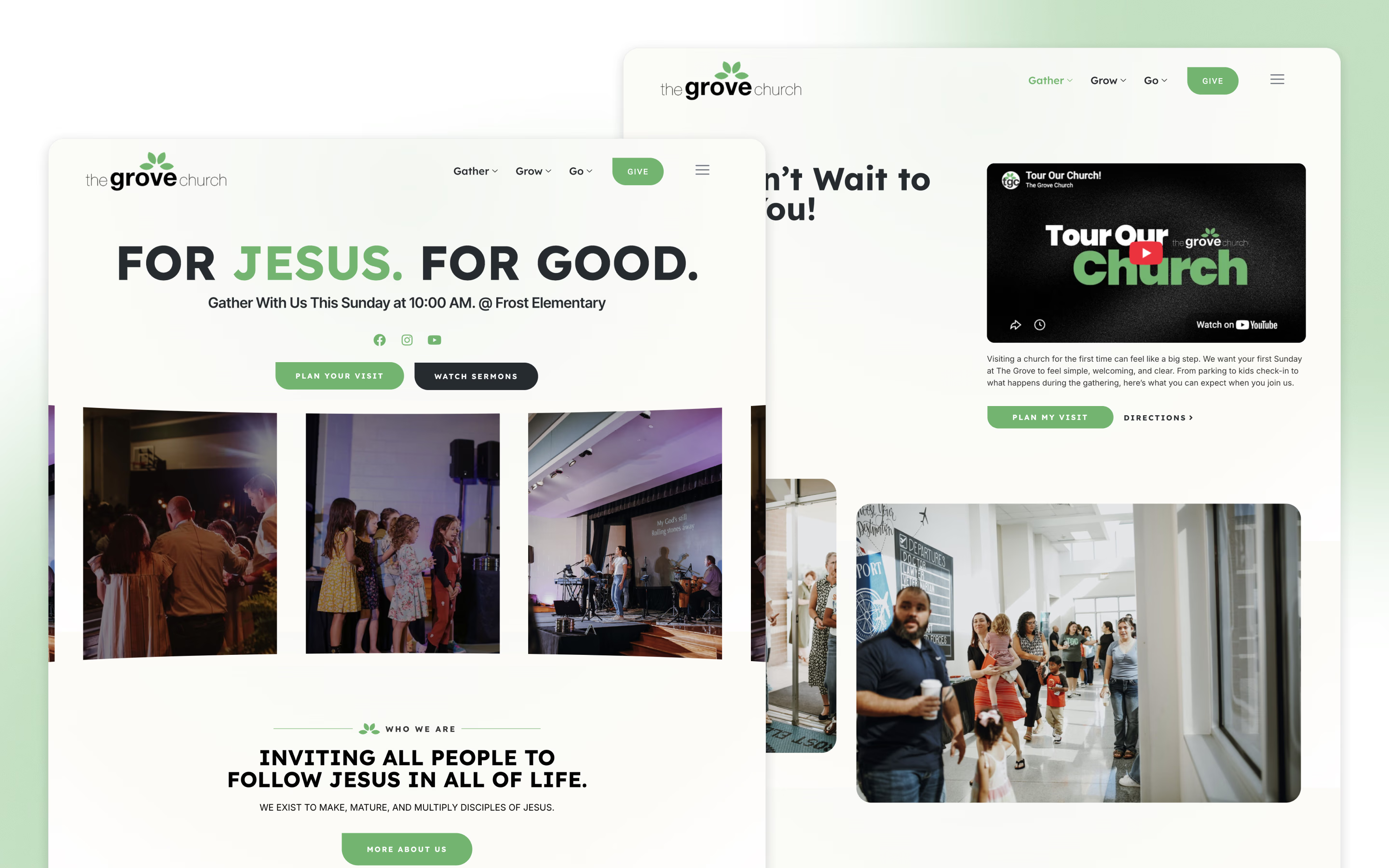
The Grove’s presentation connects its Gather, Grow, and Go message with information about attending. For your own project, use the site to discuss how an agency would keep recurring church information consistent after launch. Request a written division between the original build and the updates covered by a continuing service agreement.
13. GUDBEE: Best Church Web Design Agency for Sermon Media
 13
GUDBEE
A digital agency rebuilding church websites with mobile layouts and organized media content for congregations sharing sermons online.
GUDBEE brings a church project centered partly on how people find and watch content. Its Fifth Ward Church of Christ case includes a website rebuild, mobile presentation, and work on the church’s video and livestream experience.
This is useful when a church already has a significant media library but its website makes that material difficult to browse. A redesign should explain how existing recordings will be organized and how new ones will be added, rather than treating the archive as an afterthought.
Featured project: Fifth Ward Church of Christ
GUDBEE’s documented engagement for Fifth Ward Church of Christ in Houston included website design and rebuilding, mobile and tablet layouts, SEO work, video catalog reorganization, and livestream integration. Those are the specific contributions that make the project relevant to a church with regular recorded or live content.
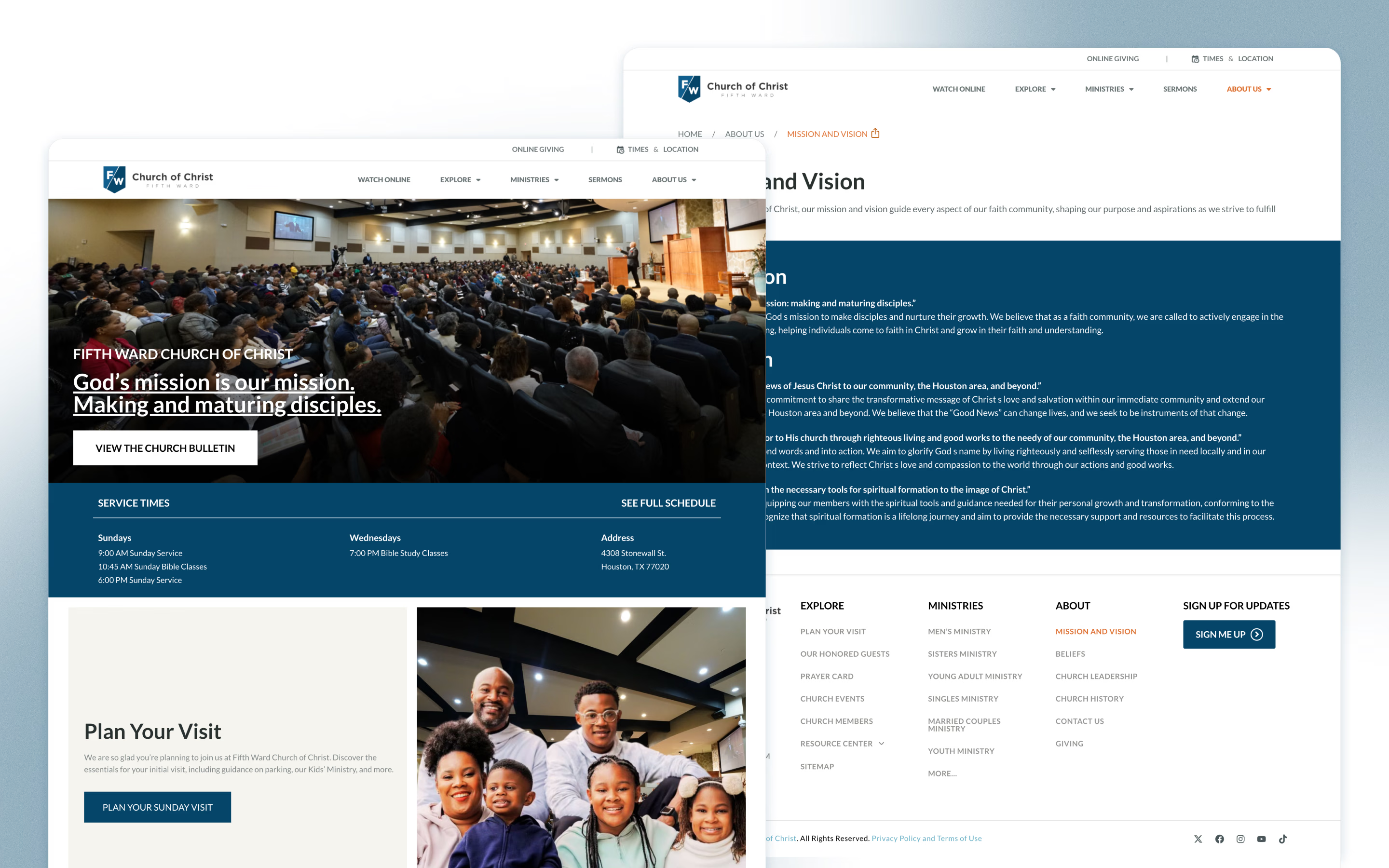
The selected pages place a congregation photograph behind a clear opening message and bring service information into visible content blocks. If media publishing is a major part of your brief, ask the agency to show the route from a live service to its archived recording. The design and publishing responsibilities should support that complete sequence.
What should a church web design agency include?
A church website project should define the information people need and the work required to keep it accurate. Start with the main page types: the church’s beliefs and story, service and campus information, ministries, leadership, sermons, events, and contact details. Ask which pages need individual design work and which will use a shared layout.
The proposal should also cover content migration, photography, copywriting, accessibility checks, mobile layouts, and launch support. Identify who will approve the church’s wording and who can supply missing material. If the current site contains years of sermons, the agency needs to know whether it is moving the whole archive or an agreed subset.
List the systems that sit behind public links, including your church management software, giving provider, registration tools, calendar, and video host. A link to an existing service, an embedded form, and a custom integration are different deliverables. Ask the agency to name the proposed connection and the responsibility for maintaining it.
How to choose a church web design agency and compare pricing
Before asking for quotes, recover access to the current domain, hosting, CMS, analytics, and connected accounts. Record who owns each one and what must remain available during the transition. This gives the agency a realistic starting point and reduces the chance of discovering an inaccessible sermon archive or domain account late in the project.
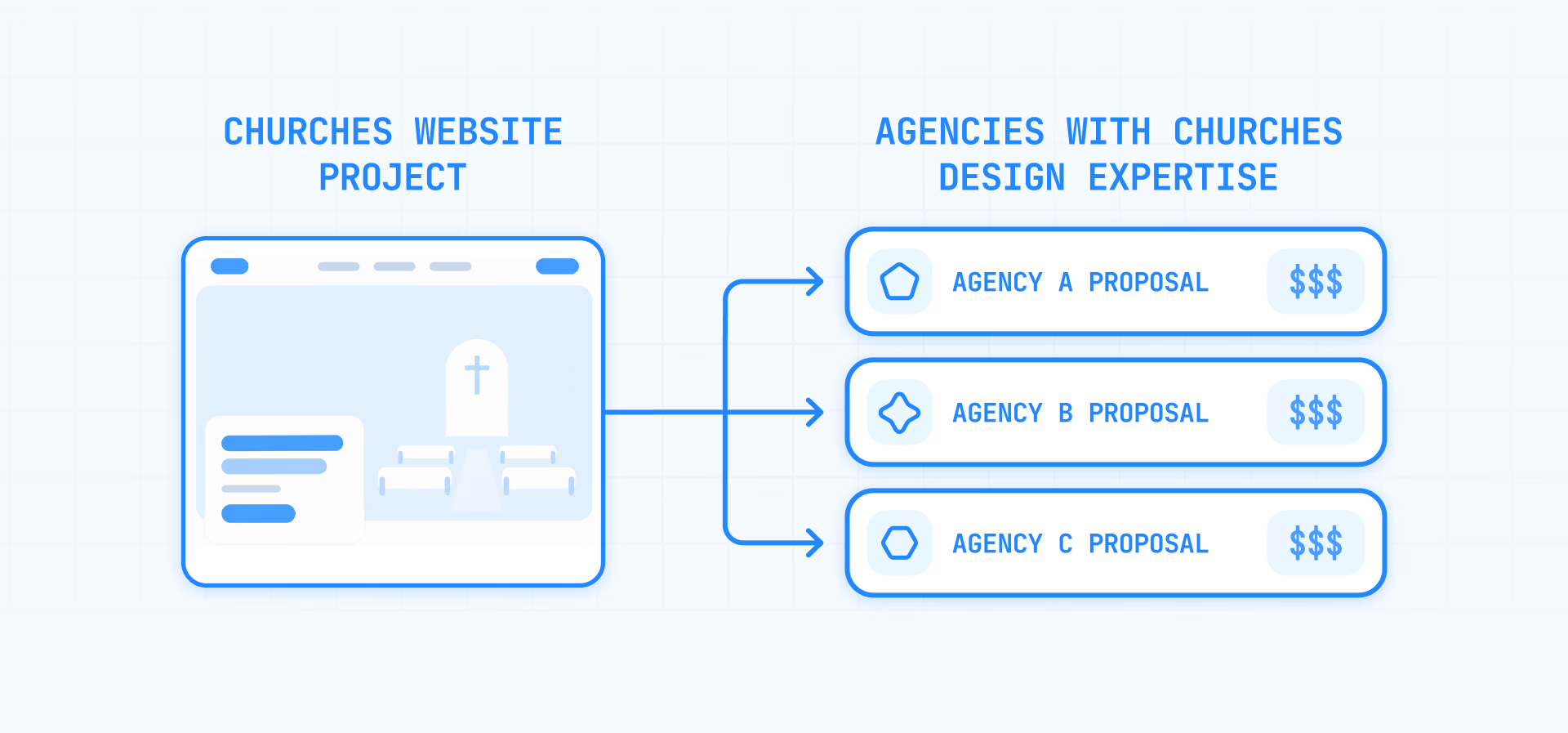
Then send the same brief to 2–3 agencies whose church projects fit your needs. Include the number of locations, main content types, publishing team, existing systems, and launch window. The email below gives you a starting point that you can adapt to your congregation.
Subject Website redesign inquiry for [Church name]
Hi [Agency team],
I found your work through BRIX Agency’s church web design agency guide. We are [Church name], a [single-location / multi-campus] congregation in [Location], and we want our next website to help newcomers plan a visit while making weekly updates easier for our team.
We need [Page types], including service and campus information, ministries, sermons, and events. Our current website is [URL], and we use [Church management system], [Giving provider], and [Video platform]. Please include the migration of [Number] existing sermons and pages, redirects, editor training, and post-launch support in your proposal.
Our preferred launch window is [Date], and our budget range is [Optional range]. Could you outline the design and development scope, content responsibilities, recurring costs, and a comparable church project?
Thank you,
[Name and role]
Compare the returned scope before comparing the total. A smaller parish website with supplied copy and a few recurring updates is a different project from a multi-campus site with sermon migration, connected events, and several approval roles. Ask each agency to separate design and development, content preparation, migration, integrations, and training in its estimate.
For the ongoing cost, request hosting, platform subscriptions, paid extensions, maintenance, and support as separate items. Establish what a support plan covers, how requests are submitted, and what happens if your church later changes providers. An affordable launch price is less helpful if your staff cannot make ordinary updates without another paid request.
Before choosing, review a comparable website the agency delivered and ask how its client maintains it. Confirm account ownership, editor access, redirect planning, testing, and post-launch responsibilities in writing. Your church should know who can resolve a broken registration link just as clearly as it knows who designed the homepage.
Choosing a CMS for your church website
The right content management system should make routine church updates straightforward while keeping the visitor experience fast and clear. Think about a normal publishing week: adding a sermon, changing a service time, posting an event, and updating a ministry page. Your staff or volunteers should have a predictable place for each task.
Webflow and Framer combine visual website tools with content collections. They can suit teams that want designed page layouts and repeatable publishing for material such as sermons or events. Confirm the proposed content model, editor permissions, platform plan, and any external tools that the website will rely on.
WordPress offers a broad publishing ecosystem and the option to choose your own hosting arrangement. A church should still know who will maintain the installation, theme, extensions, and backups. More available extensions do not remove the need for a clear decision about which features the site actually requires.
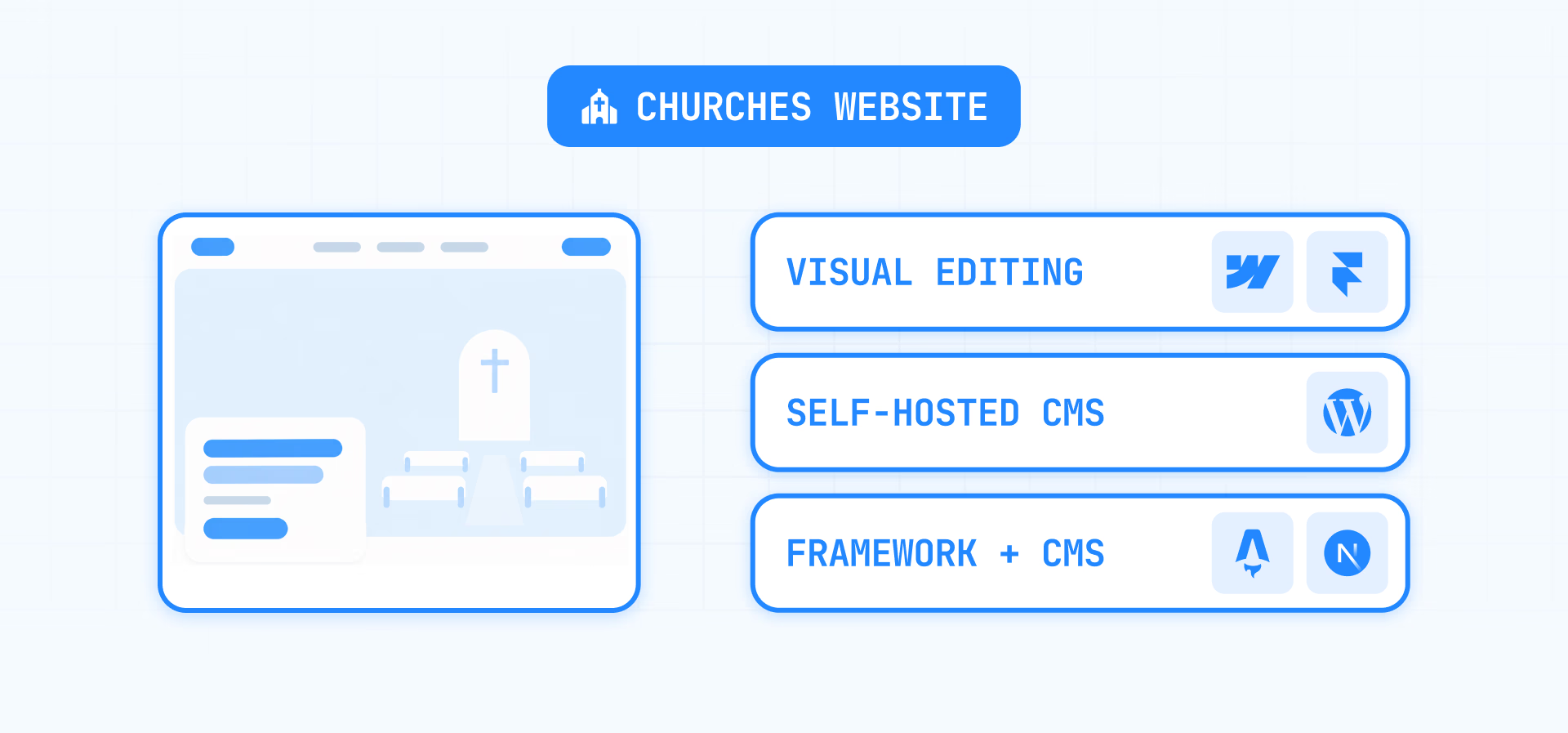
Astro and Next.js are development frameworks, so the agency must specify the separate CMS or editing interface that staff will use. These approaches can support a tailored website, but the proposal needs to include publishing access and technical maintenance alongside the build. Ask for a relevant project made with the recommended setup and an explanation of how that church keeps it current.
Church website design essentials: visits, weekly updates, and accessibility
Make a first visit easy to understand
A newcomer should be able to find service times, the correct address, arrival information, and what to expect without understanding your internal ministry names. If you have several campuses, connect each service time to its location. Include useful details about children’s check-in, entrances, and accessibility, with a contact route for questions the page does not answer.
Keep that information consistent across the homepage, visit page, campus pages, and event listings. A seasonal service change should not leave an older time visible elsewhere. Assign an owner to these details so the website remains dependable between larger redesigns.
Give sermons and events a repeatable publishing process
Define the information each sermon needs, such as title, speaker, date, series, and a recording link. Discuss how livestreams become archived content and which existing recordings will move to the new website. A useful archive helps visitors browse older teaching without forcing staff to create a new page layout every week.
For events, agree on a source of truth: the website’s CMS or an integrated church calendar. Include the date, location, audience, registration destination, and a process for removing or archiving past events. Giving links should lead to the church’s chosen provider, with recurring donations, receipts, and payment handling managed through the agreed service.
Design for different abilities and levels of confidence online
Ask the agency to check keyboard navigation, visible focus states, readable contrast, labeled forms, and sensible heading order. Church visitors may rely on assistive technology, need larger text, or be unfamiliar with common website conventions. Clear link labels and predictable navigation help them understand what will happen before they click.
Include captions or transcripts in the media publishing plan, and avoid placing essential service details only inside an image or video. After launch, give volunteers short instructions for adding accessible content and define who reviews their updates. The design provides the starting point; the church’s publishing habits help keep it usable.
Frequently asked questions about church web design agencies
When should a church hire an agency instead of using a website package?
Hire an agency when your church needs design, content organization, or integrations that its team cannot confidently plan and maintain alone. A website package may cover a small set of pages well, but a growing archive, several campuses, or a confusing visitor journey can require more detailed work than choosing a layout.
Write down the specific problems you need solved before comparing those routes. Ask what the package includes, what staff must supply, and which tasks would require outside help anyway. Then compare that full responsibility with an agency proposal covering planning, content, migration, training, and support, rather than comparing only the initial website price.
How much does a church website redesign cost?
The scope determines the price, so request an estimate based on your church’s pages, content, and connected systems. A single-location site with supplied text differs from a multi-campus build with a large sermon archive and integrated events. Photography, copywriting, and migration responsibilities also affect the amount of work an agency must include.
Send the same brief to a few relevant agencies and ask them to separate the major deliverables. Compare recurring hosting, subscriptions, maintenance, and support alongside the build cost. A useful quote tells you what will be ready at launch, what your staff must provide, and what ordinary updates will cost afterward.
Which CMS is best for a church website over the long term?
Choose around your editors, content, and maintenance capacity. Webflow, Framer, and WordPress offer different publishing arrangements, while an Astro or Next.js build needs a specified editing system alongside the framework. The right choice should make common tasks, such as posting a sermon or changing an event, straightforward for the people doing them.
Ask the agency to show a comparable church website built with its proposed setup and explain how that team maintains it. Confirm permissions, recurring costs, backups, and technical support in the proposal. A platform name alone does not establish whether your volunteers can use the finished site or whether the church can sustain its maintenance.
What should we recover before replacing our church website?
Recover account access first, including the domain registration, hosting, CMS, analytics, and services connected to the website. Churches sometimes inherit systems from former staff or volunteers, so confirming ownership early helps prevent a redesign from stalling. Also identify where existing sermon recordings, event information, photographs, and downloadable resources are stored.
Share that inventory with the agency before it finalizes migration work. Agree on which content will move, what will be archived, and how existing page addresses will redirect. Keep an accessible backup of the old content and establish who controls the new accounts. Those practical decisions protect the church’s information through the change of website.
Can volunteers update a professionally designed church website?
Yes, with a clear publishing setup and a handover designed for their responsibilities. The agency should organize recurring content into predictable fields and layouts, then provide the access and instructions volunteers need. A person adding an event should not have to recreate the page design or make unrelated changes elsewhere on the website.
List the tasks volunteers will handle, such as sermon uploads, service notices, or ministry updates, and include training in the project scope. Decide who reviews changes and who can resolve technical problems. This gives the church a practical division between routine publishing and maintenance work that may still belong to the agency or another provider.
How should a church organize sermons on its website?
Use a consistent archive with agreed information for every sermon, such as the title, speaker, date, series, and recording link. That structure helps visitors browse related teaching and gives editors a repeatable publishing task. During a redesign, the agency should also identify how much of the existing archive is included in migration.
Discuss the complete path from a live service to the archived recording, including who adds the details and where the video or audio is hosted. Include captions or transcripts in the publishing plan. A well-designed archive needs both a useful browsing experience and a reliable weekly process; the proposal should explain how the website supports each.
Can a church website accept online donations?
Yes, through a giving service connected to the website. The connection may be a clear link, an embedded form, or a more involved integration, depending on the provider and the agreed scope. Ask the agency to identify that arrangement so the church understands what is being built and which service handles payments.
Confirm how recurring gifts, receipts, account access, and provider fees will be managed before launch. The website should make the giving destination understandable, while the chosen service handles the agreed transaction features. Include ownership and support responsibilities in the proposal, especially if an existing giving arrangement needs to remain available during the redesign.
Can the new website connect to our church management software?
It can, where supported, but the agency needs to identify the exact connection rather than promising a general integration. Your church may want event listings, registrations, or other information to flow from an existing system. A public link, an embedded tool, and a custom data connection involve different work and maintenance responsibilities.
Give candidates the names of your current services and explain which information should appear on the website. Ask where that information will be edited, what happens when the source changes, and who fixes a broken connection. Review a comparable integration the agency has delivered and include the supported behavior in the written project scope.
What information belongs on a church’s first-visit page?
Answer the arrival questions that a newcomer cannot reasonably know: service times, the right address, where to enter, and what the visit will be like. Include children’s check-in information and relevant accessibility details, with a contact route for additional questions. Use ordinary language rather than relying on internal campus or ministry names.
For a church with several locations, connect those details to the correct campus and keep them consistent elsewhere on the site. Assign someone to review the information when schedules change. The agency should make the page easy to find and update, while the church supplies the local knowledge that makes it genuinely helpful to a visitor.
How do we keep church events from becoming outdated?
Choose one publishing source for events, whether that is the website’s CMS or an integrated church calendar. Define the required details, including the date, location, audience, and registration link. The design should give those fields a consistent presentation so editors do not need to build a different page for every activity.
Agree on who checks the listings and how past events are removed or archived. If information comes from church management software, confirm which changes flow through automatically and which still require staff attention. Include that process in the agency’s handover so the church can keep the calendar useful after the original project team moves on.
Find the right web design team for your church
The strongest starting point is a clear picture of what your church needs to communicate and who will maintain it. Choose a few agencies with relevant work, explore their church projects beyond the homepage, and compare how they would handle your visitor information, recurring content, and existing systems.
Bring the people responsible for weekly updates into that conversation early. Their knowledge of sermons, events, ministry pages, and service changes will help you evaluate whether a proposal fits the congregation’s real routine. A well-planned website should feel welcoming to visitors and manageable for the team behind it.
If you would like to discuss your church’s website with BRIX Agency, tell us about your congregation and the site you have in mind. We reply in less than 24 hours, typically within 1–2 hours during business hours PST, and can help you define the design and development work your project needs.





Join readers commenting on this post!